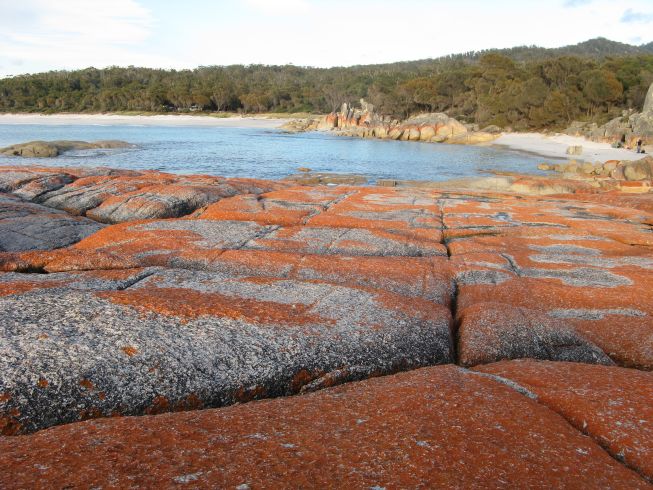
I should really add one more thing about the Bay of Fires. (it scares me a little to see how much I go on about the Bay of Fires when it wasn't even my favourite place in Tasmania. The one thing that will save you endless posts about my favourite place is probably the fact that it was a mood place more than a picturesque place. There will be few pictures, which means less posts.)
All along the beach you see below on another Google map there are several very nice campgrounds which are totally free. They only have toilets (out-houses or long-drops however you refer to them) but in St Helen which is less than 20 kilometres away you can get a free hot shower in the harbor.
You can walk along the beach I show on the map and even across the rocky points you see directly South and North of the area I have highlighted. And you can go for hours, probably even for days if you had the equipment needed. The forest on the West side has lots of really pleasant (and completely deserted from my experience) small forestry roads which makes for excellent hiking. Along those roads I was able to go to the northern beach on this map and it is a beautiful spot. One of those totally empty spots that makes you think "I cannot believe that I am here" it is that beautiful. I never saw another person there. Honestly the pictures do not do it justice.
Sunday, July 18, 2010
Tasmania - the maps (from Google maps)
I can't believe that I haven't posted maps yet.
You will recognize the "look" I am sure but all the maps on this post are from Google maps with some labels I've added.
I mean no insult, but first here is the map putting Tasmania in perspective.
And this is the Bay of Fires tucked in the North East corner of Tasmania.
And this one is just to show how much of Tasmania is still "green" protected space with no or little roads. The South West corner is basically out of reach though there is a hiking trail along the coast.
Note: I put "green" in quotation mark because all of Tasmania is very green (as the colour green). You want to imagine something a bit like jolly old British landscape in term of greenery.
You will recognize the "look" I am sure but all the maps on this post are from Google maps with some labels I've added.
I mean no insult, but first here is the map putting Tasmania in perspective.
And this is the Bay of Fires tucked in the North East corner of Tasmania.
And this one is just to show how much of Tasmania is still "green" protected space with no or little roads. The South West corner is basically out of reach though there is a hiking trail along the coast.
Note: I put "green" in quotation mark because all of Tasmania is very green (as the colour green). You want to imagine something a bit like jolly old British landscape in term of greenery.
Saturday, July 17, 2010
Tasmania Bay of Fires - Part 5
I took very few pictures of marine life. I am not sure why.
I particularly liked this algae. It looks like a string of beads ready to be a necklace.
And what is there not to like in red sea anemones?
I particularly liked this algae. It looks like a string of beads ready to be a necklace.
And what is there not to like in red sea anemones?
Tasmania Bay of Fires - Part 4
The water was so clear. It is funny but before Tasmania I associated this type of blue clear water with warm water and I tell you one thing this water was not was warm! I did manage to swim twice on warm afternoons when I was just getting back from a long hikes.
Tasmania Bay of Fires - Part 2
The Bay of Fires is best known for it red rocks.
The orange lichens on the rocks at first I thought was probably the reason for the "Fires" of the name but it isn't. Apparently the first explorers (and the book on the history of Australia is packed so I cannot checked out who it was) saw fires on the shore and this is were the name comes from.
Tasmania Bay of Fires - Part 1
Tuesday, July 06, 2010
Lucknowi Gosht Korma (or Lamb curry from Lucknow)
I love this lamb curry. The taste is complex, layered and very satisfying. I like the subtle combination of anise with the sweetness of the cardamon and kewra water and the background smokiness. The recipe comes from Raghavan Iyer's book ("660 curries").
If nothing else just read the list of ingredients, it just makes your head spin and your mouth water.
Honestly I am writing it here so that I can find it easily. Here is my version of it (I do take liberties with recipes, mostly because everything I cook has to become a one pot recipe. I don't want to wash several pots and this is the main reason why I modify recipes).
INGREDIENTS:
2 tbsp of plain yogurt
2 tbsp of grated ginger
1 tbsp of crushed garlic
1 1/4 lb of lamb cubed
2 tbsp of ghee
1 tsp black cumin (do not substitute for regular cumin if you can avoid it, what ever you do, do not use Nigella seeds sometimes called "black cumin", in this recipe "black cumin" is Kala Jeera, or Shahi Jeera)
2 black cardamon pods
2 bay leaves
2 cinnamon sticks
1 medium-size red onion sliced
1 tbsp of ground coriander
4 dried hot chilies
1/2 tsp ground nutmeg
1/4 tsp cloves
1/4 tsp ground cardamon
4 blades of mace
1 whole star anise
1 tsp of kewra water (can be replaced by rose water)
QUICK INSTRUCTIONS
1. let lamb sit in mixture of yogurt+garlic+ginger (possibly overnight)
2. let first lot of spices sizzle in ghee before adding onions. Let onion go light brown
3. add lamb with yogurt etc. Cook until it releases moisture and then until it dries and oil separate
4. add the coriander and chiles and roast then add water (a cup or so) and let simmer
5. while the lamb is cooking near the end add the rest of the spices but not the kewra water. Add kewra water at the last minute if using.
ADDED LATER:
In response to the posted comment and other verbal comment from friends I am adding details on "how to":
MORE DETAILED INSTRUCTIONS
First notice that the list of ingredients is divided into four small lists., each list of ingredient is involved in a different step, and the lists come in the same order than the steps they are involved in.
1. Mix the grated fresh ginger, the crushed garlic and the yogurt together in a mixing bowl large enough to hold the lamb. Add the cubed lamb and mixed well so the lamb is coated with the yogurt mixture. Let all this sit for at least an hour but as long as overnight if you wish. (all this involves the ingredients from the 1st list)
2. In a saucepan large enough to hold the final dish - large enough to hold all the lamb- melt the ghee over medium heat, add the black cumin, the black cardamon, bay leaves and cinnamon (everything from the 2nd list). Let the spices sizzle for a couple of minutes then add the sliced red onion. Keep on medium to low heat and fry the onion until it is light brown.
3. Add the lamb with its mixture of yogurt, ginger and garlic to the saucepan containing the fried onions and spices. Empty the bowl entirely into the saucepan. Put on medium to medium high heat and stir so that all sides of the lamb cubes are brown.
Next is the time consuming step, it should take about 20 minutes. At first the lamb will release moisture and not much stirring is required. Eventually the fluids will evaporate and the curry will not be "watery" anymore, start stirring regularly but keep cooking until the juices have the thickness of a sauce and will have a thin shinny film on top as the ghee separates.
4. Add the coriander and chilies (from the 3rd list) and continue cooking for a couple of minutes. Then add water, just enough so the lamb is like icebergs, mostly underneath the water but not totally submerge. Stir everything together and set on low heat and let simmer for at last 15 minutes, more is better. The two key factors deciding the length of the simmering step are: the meat has to cook long enough to become tender, the sauce has to have a pleasantly thick consistency. Don't let the sauce get thicker than what you want to eat, add water as needed. If you are ready too early for dinner or just rewarming the curry just add a little water and keep simmering.
5. Ten minutes before you are ready to eat add the rest of the spices (nutmeg, cloves, cardamon, mace, star anise - from the 4th list)
6. Add the kewra water at the last minute is using, stir and enjoy.
Well I hope this helps. As mentioned earlier I really only post recipes on my blogs so I can find them again when I travel so there were originally only meant as reminders to myself but somehow this recipe is turning out to be popular. Mind you the result is worth it.
If nothing else just read the list of ingredients, it just makes your head spin and your mouth water.
Honestly I am writing it here so that I can find it easily. Here is my version of it (I do take liberties with recipes, mostly because everything I cook has to become a one pot recipe. I don't want to wash several pots and this is the main reason why I modify recipes).
INGREDIENTS:
2 tbsp of plain yogurt
2 tbsp of grated ginger
1 tbsp of crushed garlic
1 1/4 lb of lamb cubed
2 tbsp of ghee
1 tsp black cumin (do not substitute for regular cumin if you can avoid it, what ever you do, do not use Nigella seeds sometimes called "black cumin", in this recipe "black cumin" is Kala Jeera, or Shahi Jeera)
2 black cardamon pods
2 bay leaves
2 cinnamon sticks
1 medium-size red onion sliced
1 tbsp of ground coriander
4 dried hot chilies
1/2 tsp ground nutmeg
1/4 tsp cloves
1/4 tsp ground cardamon
4 blades of mace
1 whole star anise
1 tsp of kewra water (can be replaced by rose water)
QUICK INSTRUCTIONS
1. let lamb sit in mixture of yogurt+garlic+ginger (possibly overnight)
2. let first lot of spices sizzle in ghee before adding onions. Let onion go light brown
3. add lamb with yogurt etc. Cook until it releases moisture and then until it dries and oil separate
4. add the coriander and chiles and roast then add water (a cup or so) and let simmer
5. while the lamb is cooking near the end add the rest of the spices but not the kewra water. Add kewra water at the last minute if using.
ADDED LATER:
In response to the posted comment and other verbal comment from friends I am adding details on "how to":
MORE DETAILED INSTRUCTIONS
First notice that the list of ingredients is divided into four small lists., each list of ingredient is involved in a different step, and the lists come in the same order than the steps they are involved in.
1. Mix the grated fresh ginger, the crushed garlic and the yogurt together in a mixing bowl large enough to hold the lamb. Add the cubed lamb and mixed well so the lamb is coated with the yogurt mixture. Let all this sit for at least an hour but as long as overnight if you wish. (all this involves the ingredients from the 1st list)
2. In a saucepan large enough to hold the final dish - large enough to hold all the lamb- melt the ghee over medium heat, add the black cumin, the black cardamon, bay leaves and cinnamon (everything from the 2nd list). Let the spices sizzle for a couple of minutes then add the sliced red onion. Keep on medium to low heat and fry the onion until it is light brown.
3. Add the lamb with its mixture of yogurt, ginger and garlic to the saucepan containing the fried onions and spices. Empty the bowl entirely into the saucepan. Put on medium to medium high heat and stir so that all sides of the lamb cubes are brown.
Next is the time consuming step, it should take about 20 minutes. At first the lamb will release moisture and not much stirring is required. Eventually the fluids will evaporate and the curry will not be "watery" anymore, start stirring regularly but keep cooking until the juices have the thickness of a sauce and will have a thin shinny film on top as the ghee separates.
4. Add the coriander and chilies (from the 3rd list) and continue cooking for a couple of minutes. Then add water, just enough so the lamb is like icebergs, mostly underneath the water but not totally submerge. Stir everything together and set on low heat and let simmer for at last 15 minutes, more is better. The two key factors deciding the length of the simmering step are: the meat has to cook long enough to become tender, the sauce has to have a pleasantly thick consistency. Don't let the sauce get thicker than what you want to eat, add water as needed. If you are ready too early for dinner or just rewarming the curry just add a little water and keep simmering.
5. Ten minutes before you are ready to eat add the rest of the spices (nutmeg, cloves, cardamon, mace, star anise - from the 4th list)
6. Add the kewra water at the last minute is using, stir and enjoy.
Well I hope this helps. As mentioned earlier I really only post recipes on my blogs so I can find them again when I travel so there were originally only meant as reminders to myself but somehow this recipe is turning out to be popular. Mind you the result is worth it.
The Wallabies and the Pademelons - part 3
I just have to show you their paws. I find them fascinating.
See what I mean?!?!?
Look at this!!! The fingers, five all line up in a row! No little crazy thumb way up the leg (like dogs or cats), just 5 fingers all lined up like petals on one side of a flower. Amazing!
The back paw is just as amazing to me.
And of course this is what you get when they hope around. I tell you when they are just running away (hoping away?) with no panic they are kind of funny and their body is kept vertical and they look like a bouncing toy. But when they are going full speed, first they are VERY fast and the position of their body is very different, leaning forward. Their back legs come forward and way up just about all the way under their chin. It is an wonderful thing to see. The science of motion tuned to excellence.
The foot prints show as one print (as photo above) repeated over and over again but quite far apart (depending on how fast they were going). The story goes that when Abel Tasman's party landed in Tasmania in 1642 they saw the foot prints that they described them a Tiger-like prints very far apart. This of course suggested to them that those belonged to very large animals and that the pace was dangerous. They sailed away and discovered New Zealand before returning to Batavia (in Java, then a Dutch colonie).
Well now you know how Tasmania got its name!
See what I mean?!?!?
Look at this!!! The fingers, five all line up in a row! No little crazy thumb way up the leg (like dogs or cats), just 5 fingers all lined up like petals on one side of a flower. Amazing!
The back paw is just as amazing to me.
And of course this is what you get when they hope around. I tell you when they are just running away (hoping away?) with no panic they are kind of funny and their body is kept vertical and they look like a bouncing toy. But when they are going full speed, first they are VERY fast and the position of their body is very different, leaning forward. Their back legs come forward and way up just about all the way under their chin. It is an wonderful thing to see. The science of motion tuned to excellence.
The foot prints show as one print (as photo above) repeated over and over again but quite far apart (depending on how fast they were going). The story goes that when Abel Tasman's party landed in Tasmania in 1642 they saw the foot prints that they described them a Tiger-like prints very far apart. This of course suggested to them that those belonged to very large animals and that the pace was dangerous. They sailed away and discovered New Zealand before returning to Batavia (in Java, then a Dutch colonie).
Well now you know how Tasmania got its name!
Monday, July 05, 2010
The wallabies and pademelons - part 2
I did get better pictures of wallabies than those I posted before. Of course those were all taken in one National Park or another. I love National Parks. I am an absolute fan.
Most of the photos, as I discovered once I went through them to see what I would post, are actually of Bennet Wallabies - a particular type of wallaby which is quite common in Tasmania.
I found it hard to take good pictures of wallabies. Their tail is quite long and you have to decide to either chop the tail or have the picture appear mostly empty. I think these first two somehow worked out.
I like this one. They often have this goofy look on their face. I always seem that they are thinking something like: "Hmmmm????"
See the one below is a pademelon. It has a rounder body and a finer face. I unfortunately do not have very many good pictures of pademelons. I really tended to see them at night a lot more than the wallabies.
The general feel of things is the hardest thing to convey in pictures. I was in Narawtapu National Park, I was the only one there and I just went for a walk at dusk. The place was incredibly quiet, there was no wind, no sound, not a motion. It was very peaceful. I watched this guy eat the leaves from the tree for a while and when he saw me he turned his head around slowly and it felt like: "Hmmm?!?! Are you looking at me? I am not here. I am not doing anything." To me it seemed that the wallabies (and the pademelons) when surprised would first stay very still and only move very slowly if they had to move until they decide to run away and then they would bolt.
The picture below reminds me of such a great moment.
Nicely they also do exactly what you expect of them such as scratching and contorting themselves into odd positions to do so.
Most of the photos, as I discovered once I went through them to see what I would post, are actually of Bennet Wallabies - a particular type of wallaby which is quite common in Tasmania.
I found it hard to take good pictures of wallabies. Their tail is quite long and you have to decide to either chop the tail or have the picture appear mostly empty. I think these first two somehow worked out.
I like this one. They often have this goofy look on their face. I always seem that they are thinking something like: "Hmmmm????"
See the one below is a pademelon. It has a rounder body and a finer face. I unfortunately do not have very many good pictures of pademelons. I really tended to see them at night a lot more than the wallabies.
The general feel of things is the hardest thing to convey in pictures. I was in Narawtapu National Park, I was the only one there and I just went for a walk at dusk. The place was incredibly quiet, there was no wind, no sound, not a motion. It was very peaceful. I watched this guy eat the leaves from the tree for a while and when he saw me he turned his head around slowly and it felt like: "Hmmm?!?! Are you looking at me? I am not here. I am not doing anything." To me it seemed that the wallabies (and the pademelons) when surprised would first stay very still and only move very slowly if they had to move until they decide to run away and then they would bolt.
The picture below reminds me of such a great moment.
Nicely they also do exactly what you expect of them such as scratching and contorting themselves into odd positions to do so.
Subscribe to:
Posts (Atom)